If you've ever watched a gaming stream or jumped into an online match and felt completely lost by the language, you're not alone. Gaming has its own vocabulary, and it can feel like everyone else got the memo except you.
This guide breaks down the most common gaming terms and abbreviations in plain English. No fluff, no assumptions. Just clear explanations you can actually use.
Why Gaming Terms Matter
Communication is a big part of online gaming. Whether you're playing with friends or strangers, knowing the right terms helps you understand what's happening, respond faster, and play better as a team.
And if you're getting into esports as a viewer, understanding the language makes the experience a lot more enjoyable. According to Statista, the global esports audience reached over 540 million in 2024. That's a lot of people watching and using these terms every day.
So let's get into it.
Common Gaming Abbreviations and What They Mean
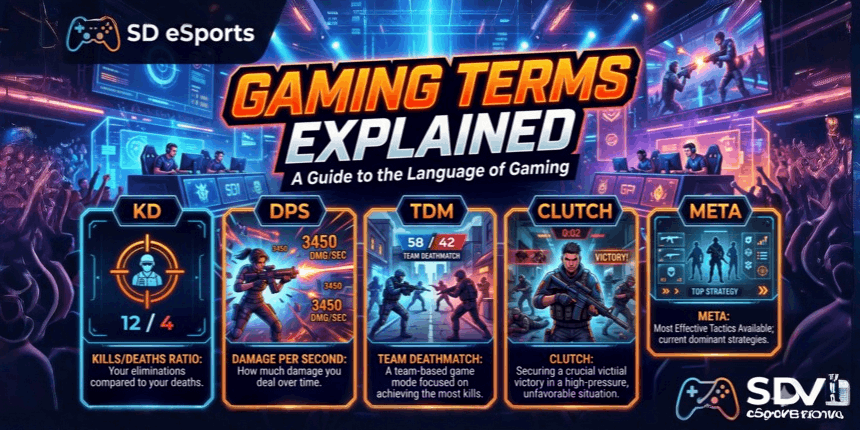
KD (Kill/Death Ratio)
KD stands for Kill/Death ratio. It's a number that shows how many kills you get compared to how many times you die.
If you get 10 kills and die 5 times in a match, your KD for that game is 2.0. Simple math.
- A KD above 1.0 means you're getting more kills than deaths
- A KD below 1.0 means you're dying more than you're killing
- Most players aim for a KD of 1.5 or higher in competitive play
KD is one of the most talked-about stats in shooters like Call of Duty, Valorant, and PUBG. But it doesn't always tell the full story. A player can have a low KD and still be incredibly valuable to their team.
DPS (Damage Per Second)
DPS means Damage Per Second. It measures how much damage a weapon, character, or ability deals every second.
This term is common in games like Fortnite, Overwatch, and most RPGs. A weapon with high DPS kills enemies faster. But high DPS weapons often have trade-offs, like slower reload times or less accuracy.
In team-based games, a "DPS role" refers to a player whose job is to deal damage. They're different from support players (who heal) or tanks (who absorb damage).
TDM (Team Deathmatch)
TDM is one of the most popular game modes in online shooters. Two teams compete to get the most kills within a time limit or before reaching a kill target.
It's one of the simplest game modes to understand, which is why it's often where new players start. No objectives to capture, no bombs to defuse. Just team vs. team.
You'll find TDM in games like:
- Call of Duty
- Halo
- Counter-Strike (as an informal mode)
- Battlefield
Clutch
A clutch is when one player wins a round or match for their team when the odds are heavily against them. Usually, it means the rest of the team is already eliminated and this one player manages to defeat multiple opponents alone.
It's one of those moments that gets everyone talking. Clutch plays are exciting to watch and even better to pull off.
You might hear:
- "1v3 clutch" — one player against three enemies
- "Clutch or kick" — a joking way of saying the pressure is on
- "He clutched it" — the player came through under pressure
Clutch moments are a big part of esports highlights for this reason. They're rare, skill-heavy, and incredibly satisfying.
Meta
Meta stands for "Most Effective Tactics Available." It refers to the strategies, weapons, characters, or playstyles that are currently considered the strongest in the game.
The meta changes constantly. When a game gets updated or a new patch drops, the meta shifts. A weapon that was dominant last month might be useless now.
Understanding the meta helps you:
- Choose the right character or weapon for ranked play
- Anticipate what opponents will be using
- Stay competitive without trial and error
You'll often hear phrases like "that's not meta anymore" or "he's playing off-meta" — meaning someone is using a less popular but sometimes surprising strategy.
More Gaming Terms Worth Knowing
Once you've got the big ones down, here are a few more that come up regularly in gaming and esports conversations.
| Term | What It Means |
|---|---|
| GG | "Good Game" — said at the end of a match as a sign of respect |
| Nerf | When a weapon or character is made weaker by a game update |
| Buff | The opposite of a nerf — when something is made stronger |
| Lag | Slow or delayed response due to poor internet connection |
| Camping | Staying in one spot to get easy kills — often seen as cheap |
| Spawn | The point where a player appears or reappears in the game |
| AFK | "Away From Keyboard" — a player who is inactive |
| RNG | "Random Number Generator" — refers to luck-based elements in a game |
| Tilted | When a player gets frustrated and starts playing worse because of it |
| Smurf | A high-level player using a low-ranked account to beat weaker players |
Esports Terms You'll Hear in Competitive Play
If you're watching esports tournaments or following pro teams, these terms come up a lot.
Rotation
Moving from one part of the map to another, usually to help teammates or reach a better position. Good rotation is a sign of smart, strategic play.
Flanking
Attacking enemies from the side or behind instead of head-on. Flanks catch opponents off guard and are often used in clutch situations.
Objective
The main goal of a match beyond just getting kills. This could be capturing a flag, planting a bomb, or holding a zone. Teams that focus on objectives often win even with fewer kills.
Economy (Eco)
In games like Counter-Strike, economy refers to managing in-game money. Teams sometimes "eco round" — saving money instead of buying gear — to afford better equipment next round.
Carry
A player who performs so well that they practically win the match for their entire team. "He carried the team" is a real compliment in gaming.
A Quick Note on Gaming Slang
Gaming terms evolve fast. New slang comes from streaming communities, pro players, and social media. What's trending today might be outdated in six months.
The best way to stay current is to watch streams on platforms like Twitch or YouTube and pay attention to how players and commentators talk. You pick it up naturally over time.
Start Playing With More Confidence
Knowing the language doesn't make you a better player overnight. But it does help you communicate, learn faster, and enjoy the experience more — especially when playing with others.
Bookmark this guide and come back whenever you hear a term you don't recognize. We'll keep adding to it as new gaming abbreviations and esports terms become part of everyday play.
And if you're gearing up for your next session, check out our gaming accessories to make sure your setup is ready for whatever comes next.
No comments yet. Be the first to comment.